


|
|
books
| book details |
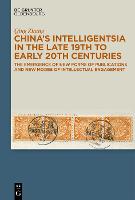
China’s Intelligentsia in the Late 19th to Early 20th Centuries: The Emergence of New Forms of Publications and New Modes of Intellectual Engagement
By (author) Qing Zhang, Translated by Xiaoqin Zhang
|
| on special |
normal price: R 6 636.95
Price: R 5 972.95
|
| book description |
Intelligentsia has been a widely used term in the studies of history and society to describe intellectual, academic, educational and publishing circles. Zhang Qing analyses the formation of Chinese intelligentsia in the context of modern China, more specifically the late Qing dynasty and Republic of China, and addresses topics such as the expansion of newspaper distributions, the relationship between newspapers and academia, the impact of newspapers on society, the change of readers’ expressions and scholars’ social mobility. The emergence of the intelligentsia and other circles in the early twentieth century is an epitome of the drastic changes in Chinese society at the time, indicative both of a new state-society relation and of Chinese scholars’ efforts to find new roles and identities for themselves after bidding farewell to imperial examinations. The author shows how both the emergence of new-type publications and new roles in academia had a profound influence on modern China. The formation of the intelligentsia at the turn of the twentieth century was not only a key to grasping modern Chinese history, but also a mirror for examining the future society.
| product details |

Normally shipped |
Publisher | De Gruyter
Published date | 18 Sep 2023
Language |
Format | Hardback
Pages | 438
Dimensions | 230 x 155 x 0mm (L x W x H)
Weight | 753g
ISBN | 978-3-1106-5719-7
Readership Age |
BISAC | history / asia / china
| other options |
|
|
To view the items in your trolley please sign in.
| sign in |
|
|
|
| specials |
|

|
Mason Coile
Paperback / softback
224 pages
was: R 522.95
now: R 470.95
|
A terrifying locked-room mystery set in a remote outpost on Mars.
|
An epic love story with the pulse of a thriller that asks: what would you risk for a second chance at first love?
|
|
|
|
|
|
