


|
|
books
| book details |
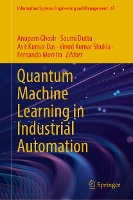
Quantum Machine Learning in Industrial Automation
Edited by Anupam Ghosh, Edited by Soumi Dutta, Edited by Asit Kumar Das, Edited by Vinod Kumar Shukla, Edited by Fernando Moreira
|
| on special |
normal price: R 6 751.95
Price: R 6 076.95
|
| book description |
This book focuses on quantum machine learning that harnesses the collective properties of quantum states, such as superposition, interference, and entanglement, uses algorithms run on quantum devices, such as quantum computers, to supplement, expedite, or support the work performed by a classical machine learning program. The devices that perform quantum computations are known as quantum computers. Quantum computers have the potential to revolutionize computation by making certain types of classically intractable problems solvable. A few large companies and small start-ups now have functioning non-error-corrected quantum computers composed of several tens of qubits, and some of these are even accessible to the public through the cloud. Additionally, quantum simulators are making strides in fields varying from molecular energetics to many-body physics. Most known use cases fit into four archetypes: quantum simulation, quantum linear algebra for AI and machine learning, quantum optimization and search, and quantum factorization. Advantages of quantum computing are many and to list a few, first, they’re fast. Ultimately, quantum computers have the potential to provide computational power on a scale that traditional computers cannot ever match. In 2019, for example, Google claimed to carry out a calculation in about 200 seconds that would take a classical supercomputer around 10,000 years. Second, they can solve complex problems. The more complex a problem, the harder it is for even a supercomputer to solve. When a classical computer fails, it’s usually because of a huge degree of complexity and many interacting variables. However, due to the concepts of superposition and entanglement, quantum computers can account for all these variables and complexities to reach a solution. Last but not the least, they can run complex simulations. The speed and complexity that quantum computing can achieve means that, in theory, a quantum computer could simulate many intricate systems.
| product details |

Normally shipped |
Publisher | Springer International Publishing AG
Published date | 2 Sep 2025
Language |
Format | Hardback
Pages | 456
Dimensions | 235 x 155 x 0mm (L x W x H)
Weight | 0g
ISBN | 978-3-0319-9785-3
Readership Age |
BISAC |
| other options |

Normally shipped |
Readership Age |
Normal Price | R 8 432.95
Price | R 7 589.95
| on special |
|
|
To view the items in your trolley please sign in.
| sign in |
|
|
|
| specials |
|
An epic love story with the pulse of a thriller that asks: what would you risk for a second chance at first love?
|

|
Matt Dinniman
Paperback / softback
480 pages
was: R 511.95
now: R 449.95
|
|
|
|
|
|
|
